Top 14 Best Crypto to Invest in 2026: Expert Analysis

The cryptocurrency market entered 2026 in a period of consolidation after a year of significant gains. Explosive moves still happen — MYX Finance surged by 3,358% in 2025 — but that kind of upside is rare and comes with equally dramatic risk. Choosing the best crypto to invest in for 2026 therefore starts with a strategic question: do you want the relative stability of established large-cap assets, or the higher-risk, higher-potential profile of early-stage projects built around specific use cases?
This guide covers both sides of that decision. It looks at large-cap cryptocurrencies with proven track records, emerging projects targeting infrastructure, payments, gaming and creator monetization, five years of Bitcoin price and volume benchmarks, and how independent rankings compare — so you can match your portfolio to your own risk tolerance, time horizon and strategy.
Key Trends Shaping Crypto in 2026
Capital is flowing toward crypto projects that expand Bitcoin’s utility, scale blockchains, and enable creator monetization. A few patterns stand out across the market:
- Projects that expand Bitcoin or Ethereum functionality attract developer and user interest.
- Platforms with real utility and active development can outperform during growth phases.
- Community-driven tokens gain traction when engagement models are strong and consistent.
- Focusing on project type and demand signals helps reduce reliance on short-term speculation.
These trends shape the shortlist below, which is weighted toward projects with real-world use cases and growing relevance across major crypto sectors rather than pure hype.
Market Snapshot: Where Prices Stand in January 2026
As of January 2026, Bitcoin is trading around $93,000, with a 24-hour trading volume of approximately $60 billion. Ethereum is priced at $3,200, while Solana trades at $133. The market capitalization of the entire crypto space stands at $3.364 trillion, a 1.6% increase compared to the close of 2024.
Altcoins are showing mixed performance, with privacy coins and DeFi platforms gaining traction. Sentiment is cautiously optimistic, with investors favoring projects that pair long-term utility with active development. Volatility remains a key concern, and disciplined risk management is essential for navigating the year ahead.
Established Large-Cap Cryptocurrencies: Stability and Scale
Well-established cryptocurrencies with proven track records and strong market presence are often favored by investors seeking lower risk. Each of the following plays a distinct role in the ecosystem:
- Bitcoin (BTC): The recognized store of value with a fixed supply, often viewed as digital gold and used as an inflation and geopolitical hedge.
- BNB (BNB): Core utility token powering the BNB Chain ecosystem, used for staking and fees, with a deflationary burn model.
- Solana (SOL): A high-throughput smart contract platform designed for high transaction processing and low transaction fees, supporting DeFi and Web3 apps.
- Ripple (XRP): Focused on fast, low-cost global payments and settlement infrastructure.
- Arbitrum (ARB): An Ethereum scaling network that reduces fees while retaining the security of Ethereum’s base layer.
- Dogecoin (DOGE): An established community-driven token with a large global community and strong brand recognition.
These assets offer stability and established use cases within the crypto space, which is why they anchor most long-term portfolios.
Emerging Crypto Projects to Watch in 2026
Several early-stage projects are focused on specific use cases such as infrastructure, payments, gaming, and community-driven ecosystems. These projects are higher risk by nature but may offer upside if execution and adoption follow through:
- Bitcoin Hyper (HYPER): Focuses on expanding Bitcoin utility through faster execution and smart contracts, with staking.
- Maxi Doge (MAXI): A community-driven meme token built around high-risk, hype-led trading culture, with staking and gamified engagement.
- BMIC: Emphasizes wallet protection and a digital-security-focused blockchain ecosystem.
- LiquidChain: Designed to connect liquidity across Bitcoin, Ethereum, and Solana.
- SUBBD: Uses AI-powered tools and tokens to support creator monetization and fan access.
- Vortex FX: Tokenized access to automated forex trading strategies.
- SpaceXRP: An XRP-themed community token tied to crypto ecosystem narratives.
- Gassed Token: A gamified, community-first meme token built on the Solana blockchain, using simple on-chain mechanics.
- Tapzi: A skill-based gaming platform offering competitive games where on-chain rewards are based on player skill.
None of these projects has the track record of the large caps above. Presale and early-stage tokens can fail entirely, so treat any allocation here as speculative capital you can afford to lose, and research each project’s team, tokenomics, and development activity before committing funds.
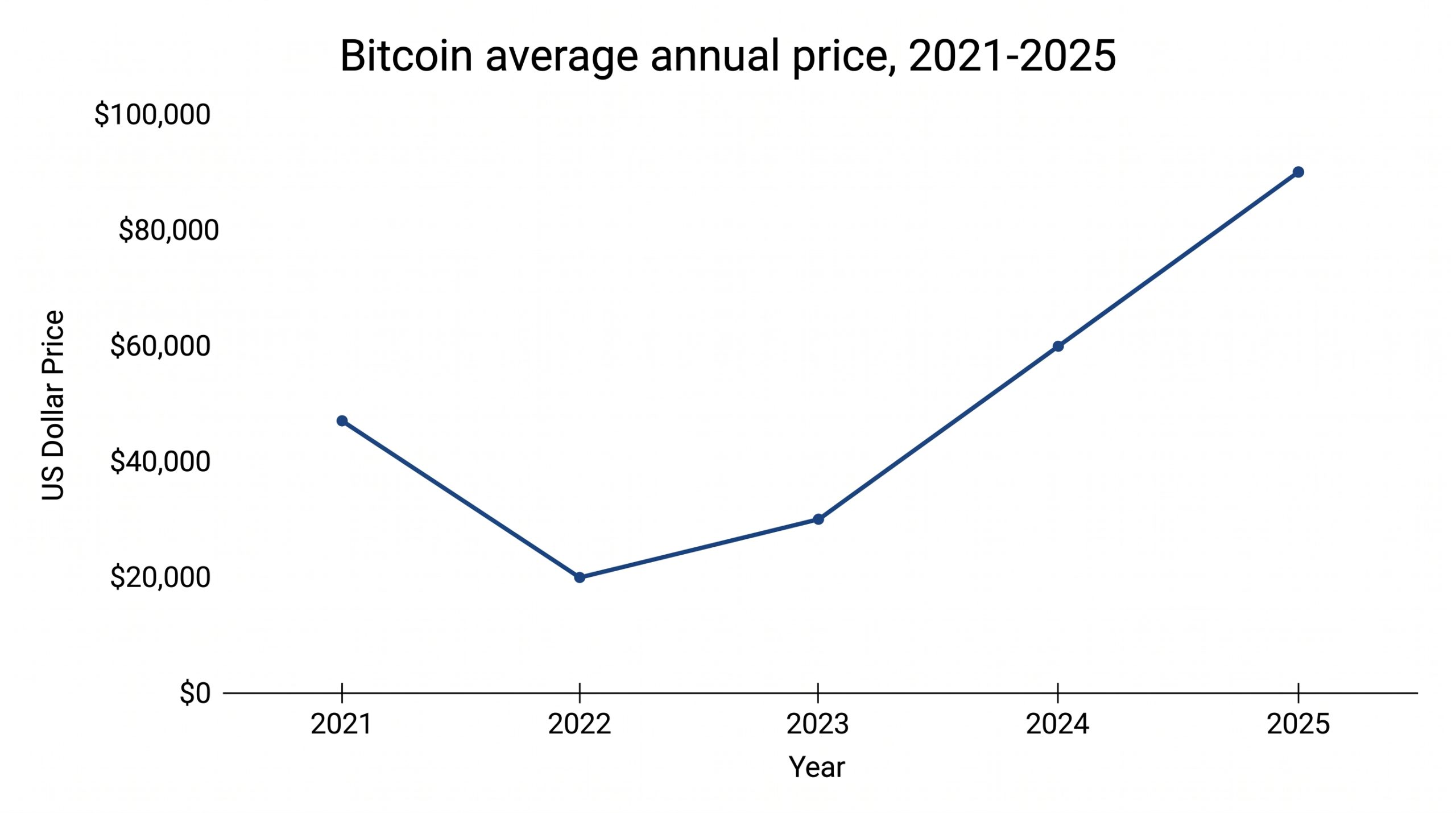
Bitcoin Price and Trading Volume: Five Years of Benchmarks
Analyzing Bitcoin’s price and trading volume together offers insight into market sentiment. Historical data reveals patterns between price surges and increased trading activity, marking periods of high investor interest and volatility:
| Year | Average Bitcoin price | Average daily trading volume | Key events |
|---|---|---|---|
| 2021 | $47,000 | $40 billion | Institutional adoption, Bitcoin ETF approval |
| 2022 | $20,000 | $25 billion | Crypto market crash, Terra Luna collapse |
| 2023 | $30,000 | $30 billion | Regulatory clarity, Bitcoin ETF hype |
| 2024 | $60,000 | $50 billion | Bitcoin ETF approval, institutional investment |
| 2025 | $90,000 | $60 billion | Increased adoption, market maturation |
Low trading volume during price declines can suggest a lack of confidence among investors, while high volume during price increases can signal strong buying pressure. Comparing these benchmarks against other cryptocurrencies helps identify broader market trends and potential entry points.
How Independent Rankings Compare
It helps to test any shortlist against independent rankings. Forbes’ list of the top 10 cryptocurrencies of September 17, 2026 ranks Bitcoin first, followed by Ethereum, BNB, XRP, Solana, TRON and Zcash — several of the same large caps covered above. CoinDCX likewise reports that Bitcoin remains the best crypto to buy now for both beginners and experienced traders, and Bitso’s top 5 cryptos to buy in 2026 names Bitcoin, Ethereum, BNB, Cardano and Solana. For utility-driven altcoins, Yahoo Finance points to Chainlink as the leading oracle coin, providing actionable data to smart contracts. The consistent presence of Bitcoin, Ethereum, BNB and Solana across these lists underlines why established assets remain the default core holding.
Lessons from 2025 Performance
Analyzing 2025 provides useful context for 2026. While Bitcoin and Ethereum faced challenges, other sectors showed significant growth. Privacy coins like Zcash and Monero gained attention, driven by concerns over transaction traceability. DeFi platforms also performed well, indicating a shift toward utility-oriented projects. Meanwhile, the decline in interest in memecoins suggested a maturing sector where solid fundamentals matter more than hype — a pattern worth remembering when weighing the community-driven tokens on this list.
How to Choose the Right Crypto for Your Strategy
The best crypto to invest in depends on your risk tolerance, time horizon, and investment strategy. Long-term investors tend to focus on fundamentals and adoption, while short-term participants look for momentum and catalysts. There is no single best cryptocurrency for everyone.
Strong projects typically share the same traits: real-world utility, active development, clear tokenomics, and alignment with broader market trends. Judging a project against those criteria — rather than chasing price action — keeps your decisions grounded when volatility spikes.
Frequently Asked Questions
What’s the best crypto to invest in right now?
There’s no single best crypto to invest in right now. Established assets like Bitcoin and Ethereum are often seen as safer long-term options. Presales such as Bitcoin Hyper, SUBBD, and SpaceXRP may offer higher upside but come with much higher risk.
What crypto under $1 will explode?
Identifying which crypto under $1 will explode is highly speculative. Projects with strong fundamentals, innovative technology, and active community engagement have the potential for significant growth — examples on this list include Gassed Token and Maxi Doge — but thorough research is essential before investing.
Which crypto has 1000x potential today?
Finding a crypto with 1000x potential is extremely difficult and risky. Early-stage projects with disruptive technology and strong use cases may offer higher potential returns, but they also carry significant risk of loss. Understand those risks fully before touching speculative assets.
What is Elon Musk’s favorite crypto coin?
Elon Musk has publicly expressed support for Dogecoin. His preferences may change, however, and celebrity endorsements are no substitute for your own research before making any investment decision.
Conclusion
The best crypto to invest in for 2026 comes down to matching assets to your goals. Large caps like Bitcoin, BNB, Solana, XRP, Arbitrum and Dogecoin offer established use cases and relative stability, while early-stage projects offer speculative upside with far greater risk. Focus on utility, active development, clear tokenomics and market alignment, size positions according to what you can afford to lose, and stay informed as the market evolves — discipline and research remain the most reliable edge available to any crypto investor.