
Juan Pardo Wins PokerStars $1,050 SCOOP Warm-Up


If you’ve ever watched a high-stakes online final table and felt that familiar mix of admiration and dread, admiration for the precision, dread for how fast everything can flip, you’re not alone. The PokerStars $1,050 SCOOP Warm-Up is exactly that kind of pressure cooker, and Juan Pardo’s win wasn’t just “another title.” It was a clean example of how elite players turn thin edges into real money when everyone at the table knows what they’re doing.
And if you come at this as an investor or business-minded operator, it’s hard not to see the parallels. Tournament poker is a living lab for decision-making under uncertainty: variance, position sizing, downside control, and the discipline to stick to a plan when the noise gets loud. Let’s break down what this event is, what Pardo actually did to win it, and what you can take from it, both for your poker schedule and, yes, your portfolio.
Key Takeaways
- Juan Pardo takes down the PokerStars $1,050 SCOOP Warm-Up by turning small, uncomfortable edges into consistent chip accumulation in an elite field.
- The $1,050 SCOOP Warm-Up isn’t a “soft opener”—the four-figure buy-in concentrates strong regulars, making patience, range depth, and disciplined aggression the real differentiators.
- Pardo’s final-table advantage came from stack leverage and clean pressure, winning many medium pots that quietly build leads without needing headline hero calls.
- In heads-up play, Juan Pardo protected his edge by avoiding ego-driven “finish” spots and prioritizing low-mistake lines that prevent one big swing from flipping the match.
- ICM and pay-jump awareness matter more in top-heavy payouts, so strong players choose $EV-safe decisions even when a play looks slightly +chipEV.
- Treat high-stakes tournament volume like a portfolio: set shot-taking limits, use structural stop-loss rules, and manage fatigue to reduce tilt-driven leaks during series weeks like SCOOP.
What The $1,050 SCOOP Warm-Up Is And Why It Matters
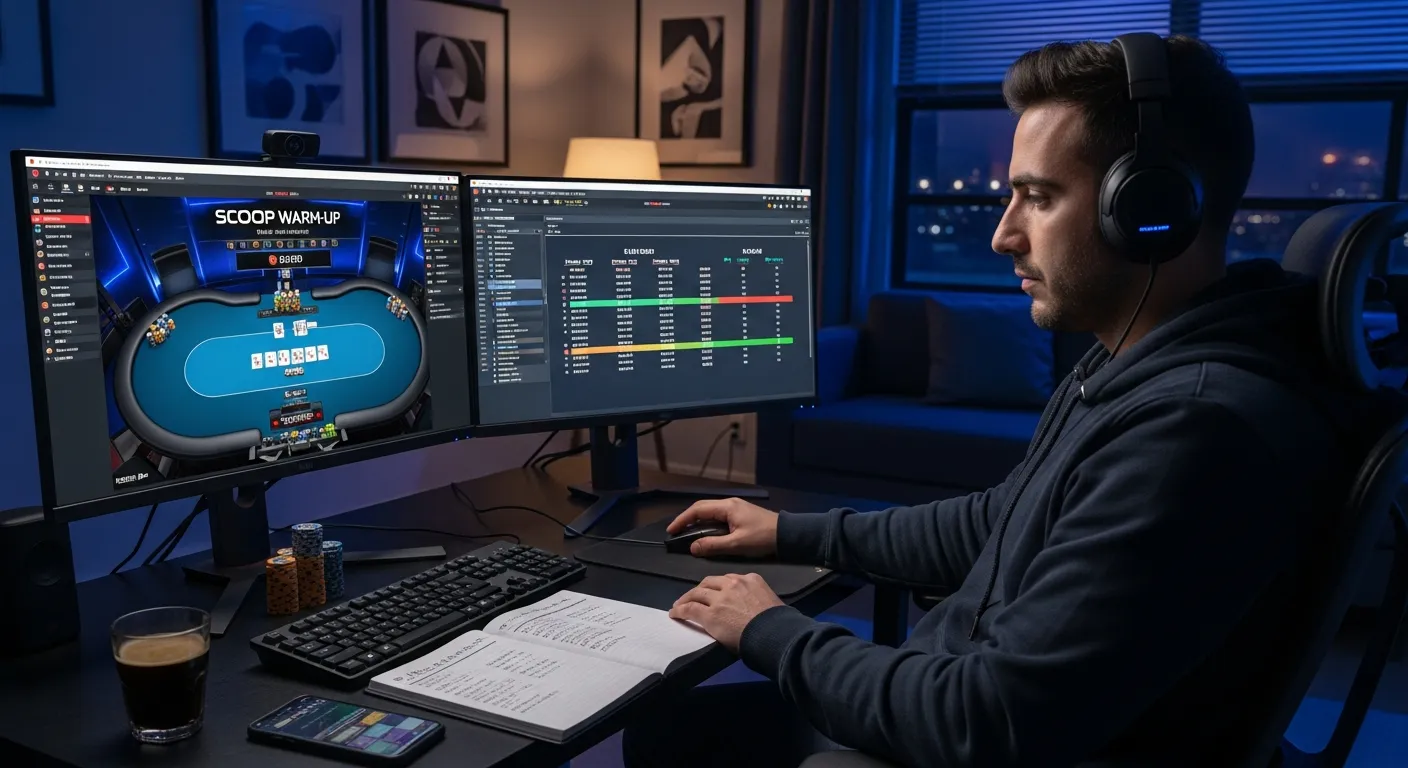
The “Warm-Up” label tricks a lot of people. This isn’t some casual on-ramp where players splash around before the real fireworks. In practice, a $1,050 buy-in SCOOP Warm-Up is one of those events where the table feels like a private game that accidentally got listed in the lobby.
At this price point, you’re not paying for entertainment. You’re paying for access to a field that largely understands preflop construction, stack-depth play, and ICM. Which means the edges aren’t the obvious ones. They’re smaller, sharper, and they show up when you’re willing to take the uncomfortable line at the right time.
How SCOOP Warm-Up Events Fit Into PokerStars’ Major Tournament Calendar
SCOOP on PokerStars is still one of the main stages for online tournament poker. The Warm-Up events sit in a useful spot: early enough that everyone’s fresh and hungry, but significant enough that you’ll see serious preparation.
In my experience, early-series events have a distinct feel. Pros aren’t yet exhausted by two weeks of late nights. Study groups are active. People are paying attention to population trends as they happen. When you win one of these early marquees, you’re not just collecting a payout, you’re sending a signal to the player pool that you’re locked in.
Why A $1,050 Buy-In Draws Elite Fields And Sharper Edges
A four-figure buy-in filters the field in a specific way. Recreational players still show up, but the ratio shifts. You get more “reg density,” more strong fundamentals, and far fewer punted stacks.
That changes everything. Open sizes tighten. 3-bets and 4-bets are more purposeful. Postflop lines become more polar, and the “free money” spots mostly disappear.
So why does this matter? Because when the field is strong, your biggest advantage often comes from your ability to stay patient and keep making good decisions when the payoff isn’t immediate. Juan Pardo’s win fits that pattern. It’s not a highlight reel of hero calls. It’s a demonstration of control.
Final Table Recap: Key Moments That Defined Juan Pardo’s Title Run
Final tables at this level aren’t about who knows the most theory. Everyone has charts. Everyone has studied. The separation happens in tempo: who senses when the table is stuck, who applies pressure without donating, and who keeps their stack out of danger while still accumulating.
What stood out in Pardo’s run was how “un-dramatic” it looked. And I mean that as a compliment. He didn’t need chaos. He needed reps: solid opens, well-chosen 3-bets, and an ability to force opponents into awkward stack decisions.
Momentum Shifts, Stack Pressure, And Critical Pots
Online, momentum is a funny thing. It’s not emotional energy, it’s stack leverage. When Pardo gained chips, he didn’t immediately start torching the table with random aggression. He used the stack the way you’d use strong market positioning: you press where others can’t comfortably fight back.
Short and middling stacks feel trapped at a tough final table. They want ladders. They want clean spots. So when a bigger stack puts them in spots where calling feels risky and folding feels humiliating, mistakes happen.
The key moments in these events are often the medium-sized pots that don’t make headlines: a defended blind where the in-position player chooses a size that makes the turn miserable, or a river spot where a thin value bet forces a disciplined fold from a capped range. Those are the pots that quietly build a lead.
Heads-Up And Closing Lines: Converting An Edge Into A Trophy
Heads-up is where a lot of technically strong players still leak. The ranges get wide, the positions swap every hand, and your ability to keep pressure without punting starts to matter.
Pardo’s closing looked like someone who’s done it before. He didn’t chase knockouts with ego bets. He kept decisions clean. When you’re ahead, you don’t need to win every pot, you need to avoid the one big mistake that flips the match.
That’s a business lesson, too. When you’ve got an edge, you protect it. You don’t bet the quarter on a coin flip just because you’re impatient to “finish.” You take lines that let the opponent be the one who has to swing.
Who Juan Pardo Is: Track Record, Style, And What Sets Him Apart
If you follow high-stakes tournament poker at all, you’ve seen Juan Pardo’s name in serious places. He’s one of those players who shows up across formats and doesn’t need a big storyline to be dangerous. The results speak for themselves, but the more interesting part is how his profile fits the modern top tier.
He’s not only a “one series” threat. He’s a repeat performer, which is what you care about if you’re thinking in expected value instead of one-off headlines.
From High-Roller Results To Online Consistency
A lot of players can spike a big score. Far fewer can repeatedly run deep when the fields are stacked with competent pros.
Pardo has built a reputation around doing well in tough environments, including high rollers, where the mistakes are smaller and the punishments are bigger. That carries over online. When the average opponent is capable, consistency becomes the real flex. You’re not farming errors, you’re winning because you choose better lines slightly more often.
That’s the kind of track record that matters to you as an investor, too. Anyone can get lucky once. You’re looking for repeatable processes.
Common Traits In Pardo’s Game: Discipline, Pressure, And Range Depth
Three traits tend to show up in players like this.
First, discipline. Not the loud kind. The boring kind: not forcing action when the spot isn’t there.
Second, pressure. Not reckless aggression, but pressure tied to structure, stack sizes, positions, payout jumps. He applies heat when it’s hardest to respond correctly.
Third, range depth. This is where many good players still simplify too much. At high stakes, simplification gets punished. When your range has the right blends, strong hands, draws, air that makes sense, you become hard to play against, and opponents can’t just wait you out.
If you’ve ever invested through a messy market, you’ll recognize this. The best operators don’t “predict.” They build a range of scenarios, then choose actions that hold up across them.
The Meta Behind A High-Stakes Warm-Up Win
When you watch a strong player win one of these, it’s tempting to reduce it to, “He ran good.” Sure, cards matter. But in a sharp field, the winner usually makes more of the table dynamics than the table makes of them.
The real meta is understanding what competent players do by default, and when they’ll still overfold, underbluff, or choose the wrong bet sizing because the payout structure is squeezing them.
ICM And Pay-Jump Navigation In Tough, Top-Heavy Payouts
In a top-heavy payout, the tension is constant. Chips aren’t linear. Winning a pot doesn’t feel the same as losing a pot, because the downside often costs you more than the upside pays.
That’s ICM in plain English. And at a final table with strong players, you’re not only playing hands, you’re playing incentives.
I’ve found that many people “know” ICM but still act like it’s a trivia fact instead of a force. They’ll take a slightly +chipEV spot that’s quietly -$EV because busting there is catastrophic. Players like Pardo tend to respect the gravity of the moment without going into a shell.
Exploits Versus Balance: Adjusting When Everyone Is Competent
Against weaker fields, you can print money with simple exploits. Against strong fields, you still exploit, but you do it with restraint.
The trick is choosing targets. Even good regs have habits. Some defend blinds too tight when short. Some avoid thin river calls because they hate being wrong on stream or in replays. Some 3-bet plenty but don’t pull the trigger on enough turn barrels.
When everyone is competent, your job isn’t to be “creative.” It’s to be accurate. You pick the adjustment that fits the opponent and the stack depth, then you move on. No theatrics.
That mindset should feel familiar if you manage capital. You don’t need to outsmart the entire market every day. You just need a few reliable edges and the discipline to take them when they appear.
Bankroll, Risk, And Mindset Lessons For Serious Online Players
If you’re reading this as someone who thinks in terms of risk, drawdowns, probabilities, worst-case scenarios, then tournament poker is probably already appealing. It’s a brutal teacher, but it’s honest.
A $1,050 tournament isn’t “expensive” or “cheap” in a vacuum. It’s expensive if it’s outside your plan. It’s reasonable if it’s a controlled shot inside a bigger system.
Shot-Taking Frameworks And Stop-Loss Rules For Tournament Grinds
Shot-taking is where a lot of smart people still self-sabotage. They win a few buy-ins, feel invincible, and suddenly their schedule is a mess.
You’re better off treating shots like a business expense with a clear limit. Decide ahead of time how many attempts you’ll take at a given stake before you step back. And decide what success looks like. Is it a cash? A deep run? Or is it simply playing well without punting because the money feels heavy?
In my experience, the best stop-loss isn’t emotional. It’s structural. When you know the rule beforehand, you don’t negotiate with yourself at midnight.
Tilt Control And Volume Planning During Big Series Weeks
During big series weeks like SCOOP, volume is seductive. There’s always another event starting. There’s always a reason to register “just one more.”
But your A-game has a limited battery. If you’re serious, you plan your week the way you’d plan a demanding work trip: sleep, food, breaks, and a realistic cap on how late you’ll be firing tournaments.
Tilt usually isn’t one dramatic outburst. It’s a slow leak. You start calling in spots you’d normally fold because you’re tired of being pushed around. Or you 4-bet because you want to “send a message.”
If you’ve ever traded through a choppy market, you know this feeling. The cure is boring: fewer decisions, better rest, and rules you follow even when you don’t feel like it.
The Finance Angle: What Poker Tournament Economics Teaches Crypto Investors
You don’t need to play poker to learn from it. But if you already invest in crypto, poker’s framework can help you think more clearly about what’s skill, what’s variance, and what you should do when the chart messes with your head.
And since you’re likely tracking markets anyway, a hub like Cryptsy can be useful for keeping your information flow clean, real-time updates, analysis, and education in one place, so you’re not making decisions based on random noise.
Expected Value, Variance, And Why Short-Term Outcomes Mislead
Expected value is the north star in both poker and investing. You can make a good decision and lose money. You can make a bad decision and get paid. The short-term result doesn’t prove anything.
That’s hard to live with, especially if you’re competitive. But it’s the truth.
Tournament poker makes this painfully obvious because the distribution is lumpy. You might be a strong player and still go weeks without a big score. Crypto can feel the same: a position can be right on fundamentals and still get dragged around by sentiment.
The lesson is not “ignore outcomes.” The lesson is to judge yourself on process first, outcomes second. Keep receipts. Track decisions. Review your reasoning.
Position Sizing, Drawdowns, And Survival Through Volatility
In tournaments, position sizing shows up as buy-in selection and volume. In crypto, it’s literally position size.
If you size too big, you don’t just risk losing money, you risk losing your ability to keep playing. That’s the real disaster. Survival buys you time, and time is where edges pay.
Think of a tournament bankroll as your trading capital. You’re not trying to avoid all losses. You’re trying to avoid the kind of loss that forces you out of the game.
That’s why serious players care about drawdowns and worst-case scenarios. Not because they’re pessimists, but because they’re professionals.
When you watch someone like Pardo convert thin edges at a final table, you’re watching a person who understands that staying alive, staying liquid, and staying composed is part of the strategy, not something you bolt on afterward.
What This Win Could Mean For The Rest Of SCOOP Season
Early marquee results change behavior. Not always dramatically, but enough that you can feel it if you’re paying attention.
A win like this can tighten some players up and loosen others. Some regs start taking more shots because they feel the money is “in the air.” Others become more careful because they’ve already taken a hit or two and don’t want to dig a hole.
Field Behavior Shifts And Reg Density After Early Marquee Results
After an early high-stakes event, you often see a subtle migration. Players who ran deep feel confident and register more. Players who bricked a few may either chase or retreat.
For you, the practical takeaway is simple: don’t assume the field stays the same day to day. Table lineups, late registration patterns, and risk appetite can shift across the series.
If you’re choosing which events to play, pay attention to when the toughest players are most likely to show up in force. Sometimes it’s weekends. Sometimes it’s the trophy events. Sometimes it’s the exact opposite, some “in-between” tournaments can be softer because the headline event is running at the same time.
Players And Storylines To Watch In Upcoming High-Buy-In Events
Pardo’s win puts a spotlight on him for the rest of the series, whether he wants it or not. People adjust. They look for what they think they saw at the final table. Some will over-adjust.
The bigger storyline, though, is always the same in high buy-ins: who stays disciplined as the schedule gets dense.
If you’re following along, watch for repeat deep runs from the same names. Not because it’s “destiny,” but because repeat appearances usually mean their decisions are traveling well across formats and structures. That’s the closest thing poker has to a reliable signal.
And if you’re thinking like an investor, it’s the same signal you look for in markets: not one green candle, but a pattern of good execution over time.
Conclusion
Juan Pardo taking down the PokerStars $1,050 SCOOP Warm-Up isn’t just a cool headline. It’s a clean case study in how professionals win when the room is full of other professionals.
If you want the real takeaway, it’s this: you don’t need flash to win at high stakes, you need a plan, respect for risk, and the patience to let small edges stack up. That’s true at a final table, and it’s true when you’re managing capital in volatile markets.
So if you’re grinding tournaments, treat your schedule like a portfolio. If you’re investing, treat your decisions like hands you’ll have to review later. Either way, the people who last are the ones who stay honest about variance and keep showing up with their best process.
Frequently Asked Questions
What is the PokerStars $1,050 SCOOP Warm-Up, and why is it such a tough event?
The PokerStars $1,050 SCOOP Warm-Up is a high buy-in early-series tournament that regularly attracts elite online players. At this stake, most opponents understand preflop ranges, stack-depth strategy, and ICM, so “easy” mistakes disappear and wins come from converting thin edges consistently.
How did Juan Pardo win the PokerStars $1,050 SCOOP Warm-Up?
Juan Pardo’s title run was defined by disciplined, low-drama execution: solid opens, selective 3-bets, and using stack leverage to pressure shorter stacks without spewing chips. Instead of hunting hero moments, he kept opponents in uncomfortable decisions and steadily accumulated in many medium-sized pots.
What does ICM mean at a final table like the PokerStars $1,050 SCOOP Warm-Up?
ICM (Independent Chip Model) explains why chips aren’t worth the same amount of money at a final table—especially in top-heavy payouts. Busting can be far more costly than winning a small edge, so strong players balance aggression with downside control and choose lines that protect tournament equity.
Why do $1,050 buy-ins create “sharper edges” and more reg-heavy fields?
A four-figure buy-in filters out many casual entries and increases “reg density,” meaning more players with strong fundamentals. Opens tighten, 3-bets become more purposeful, and postflop lines get more polarized. That forces you to rely on patience, range depth, and precise pressure rather than obvious punts.
What bankroll rules should I follow before shot-taking a $1,050 online tournament?
Treat a $1,050 event like a planned business expense, not an emotional gamble. Set a predefined shot limit (how many buy-ins you’ll take), define success as decision quality (not just cashing), and use structural stop-loss rules so you don’t expand stakes mid-series when fatigue and variance spike.
How is tournament poker similar to crypto investing in terms of risk and expected value?
Both poker and crypto punish outcome-based thinking. You can make a good +EV decision and still lose in the short run due to variance. The practical overlap is process: position sizing to survive drawdowns, tracking decisions for review, and avoiding oversized risk that can knock you out of the game.
